

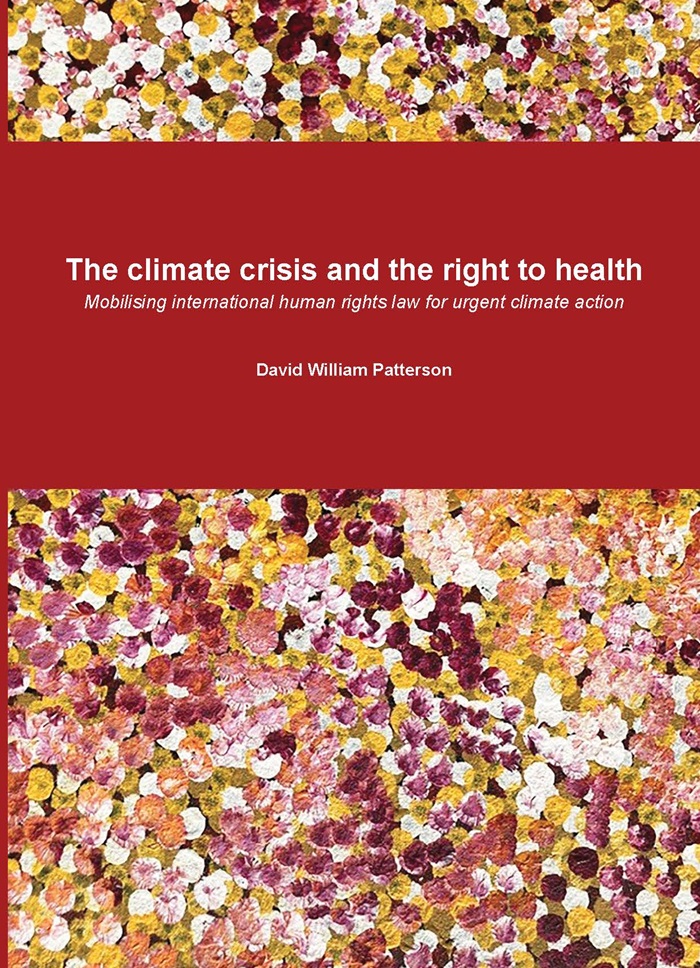
The effects of climate change on global health are well-recognised and increasingly dire. This dissertation of David Patterson addresses the question ‘How can international human rights law be better mobilised to protect and promote human health in the climate crisis?’ The research was supervised by prof. Brigit Toebes, who passed away in May 2026. Her legacy continues, including through the Groningen Centre for Health Law and the work of the many colleagues around the world whom she mentored and inspired. Associate professor Marlies Hesselman contributed an invaluable climate law perspective as second supervisor. Patterson acknowledges his perspective as an economically privileged developed world gay cis male baby boomer! As a ‘pracademic’, the author’s research built on over two decades’ professional experience in designing and implementing health law capacity-building projects in low- and middle-income countries, first on HIV, and later on NCDs and pandemic preparedness. The dissertation contains and introduction, four articles which have been published in peer-reviewed academic journals, and a conclusion which reflects on the common threads emerging through the research. The author also sought to use his position at the University to engage and support colleagues in Europe and in low and middle income countries to accelerate climate action. In this capacity he co-founded the human rights and climate change working group of the Netherlands Network for Human Rights Research, and the law and public health section of the European Public Health Association. Through these initiatives and through the Faculty of Public Health (UK), he has advocated for the right to health as a leading argument for climate action. While much of the dissertation is grounded in doctrinal legal analysis, several sections are inherently ‘interdisciplinary’, understood as legal research which incorporates methods and insights from non-legal disciplines. A systematic review of academic literature reveals that health and legal experts often use phrases like ‘the right to health’ differently, causing confusion. Patterson calls for closer teamwork between these fields. Public protest and online participation are vital. To tackle climate change effectively, governments must protect ‘civic space’ so citizens and health professionals can safely voice their concerns and influence policy. While wealthy nations are slow to provide promised climate funding, developing nations are missing opportunities to demand this support. They are also failing to report on how they consult children during official United Nations treaty reviews. The dissertation argues that climate advocates can learn greatly from the global response to HIV. While focusing solely on environmental science can cause public denial, the HIV response succeeded by using human rights law, social mobilization, and legal action to hold governments and corporations accountable. The dissertation concludes that international human rights law is a powerful but under-utilized tool for climate action. By utilizing recent legal milestones – such as the 2025 International Court of Justice advisory opinion – the global community can better address the threat of climate change to human health.
Patterson will defend his thesis on September 14th, at the Rijksuniversity of Groningen. Supervisors: prof. Birgit Toebes and prof. Marlies Hesselman.
David Patterson
The Climate Crisis and the Right to Health: Mobilising International Human Rights Law for Urgent
Climate Action
The dissertation will be deposited with the University of Groningen library