

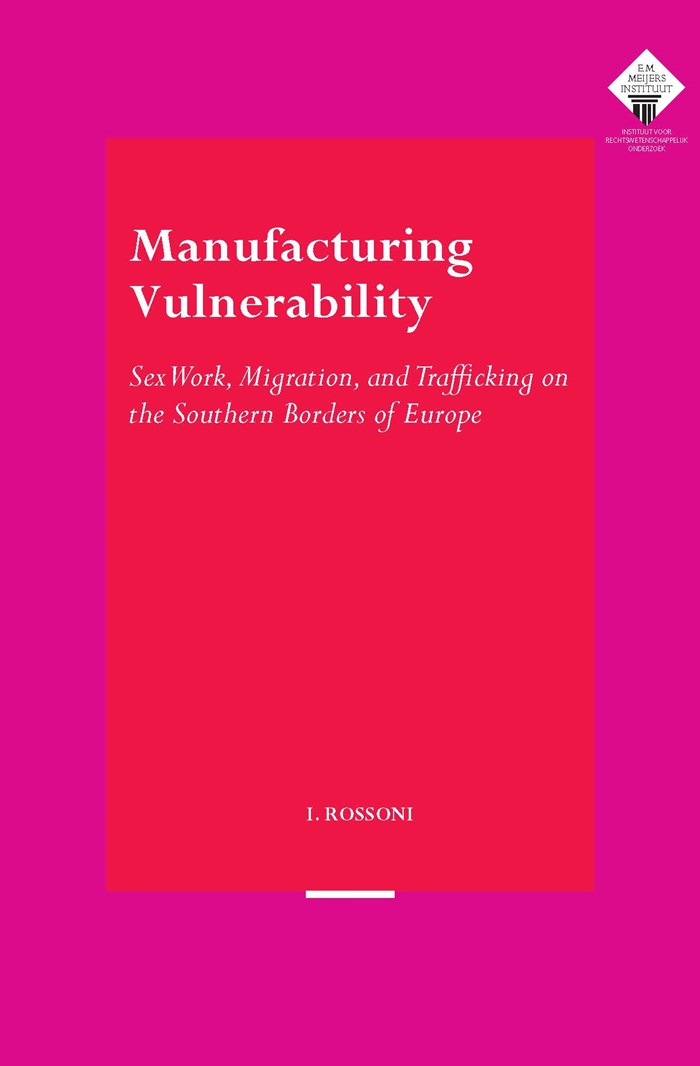
The doctoral thesis of Isotta Rossoni is a socio-legal research project which employs policy analysis, digital imagery content analysis, and qualitative fieldwork to examine how ‘vulnerability’ is constructed, deployed, and experienced within the contexts of migration, sex work, and trafficking in Southern Europe. Building on scholarship that views vulnerability not as a neutral or purely protective concept but as a political tool, the first part of the thesis analyses how institutions and professionals – such as EU policymakers, NGOs, law enforcement, and media – construct vulnerability from the top down.
Common representations paint vulnerability as an individual trait, with migrant sex workers, especially women, framed as passive victims needing rescue, reinforcing gendered, racialised, and migration-based
stereotypes. Vulnerability is therefore often used politically to designate ‘victims’ worthy of protection and justifying punitive, securitised approaches while overlooking the structural role of migration, labour, and other policies in producing vulnerabilities. The first part of the thesis examines how vulnerability is conceptualised and constructed across multiple sites, including EU policy documents on trafficking and smuggling, digital imagery, and the reported outcomes of EU-funded anti-trafficking initiatives. Within EU trafficking policy discourse, it is often overemphasised to reinforce dominant narratives of sexual exploitation, with a particular focus on women and children, while sidelining other experiences and forms of harm. In contrast, within EU smuggling discourse, vulnerability is frequently downplayed, enabling states to deflect attention from restrictive migration regimes that contribute to migrants’ precarious conditions. EU-funded initiatives tend to privilege projects that align with dominant framings – particularly those focused on sexual exploitation – thereby incentivising organisations to reproduce narrow, and at times carceral, understandings of vulnerability. At the same time, digital imagery and media representations reinforce these narratives by circulating racialised and gendered depictions of ‘ideal’ victims. Across these contexts, vulnerability operates less as a basis for protection and more as a mechanism of categorisation, surveillance, and governance of marginalised populations, obscuring the structural conditions that produce exploitation. The second part of the thesis turns to lived experience, drawing on the testimonies of approximately 30 participants with experiences of sex work and migration to Malta, to challenge top-down constructions of vulnerability through a constructivist grounded approach. Contrary to dominant depictions, vulnerability emerges not an inherent trait but a condition produced by legal precarity, stigma, inequality, and policing. From this, the study develops a framework outlining six dimensions of vulnerability and introduces the concept of vulneramentality, a form of governance that produces and controls populations through the language of vulnerability. Vulneramentality reveals how structures and policies amplify inequalities and produce vulnerability. For example, while sex work is not formally illegal in Malta, indirect criminalisation via policing, surveillance, and ambiguous regulation disproportionately targets migrant sex workers, especially those racialised or undocumented, creating insecurity that restricts rights and increases harm. Although individual coping strategies and peer support networks exist, systemic pressures and stigma limit collective resistance. Thus, vulneramentality produces vulnerability while constraining possibilities for challenging it. Overall, the thesis argues that current policies fail because they impose narrow definitions of vulnerability that overlook lived realities. It calls for reconceptualising vulnerability as a dynamic, structural condition and as a potential site for solidarity and political action. Instead of justifying control, vulnerability should inform inclusive, rights-based approaches that address underlying inequalities and centre the voices of those most affected.
Rossoni defended her thesis March 20th, 2026 at the University of Leiden. Supervisors: prof. Maartje van der Woude and prof. Joanne van der Leun.
Isotta Rossoni
Manufacturing Vulnerability: Sex Work, Migration, and Trafficking on the Southern Borders of Europe
The thesis is accessible via Leiden University’s Repository and is published by the Meyer Institute as MI 461. All individual chapters are also accessible via open access via the following journals: European Journal of Criminology, 0 (0), 1-26; International Journal for Crime, Justice and Social Democracy, 2-15. doi: 10.5204/ijcjsd.3909; Journal on Migration and Human Security. doi: 23315024251316543; Anti-trafficking review, 23, 98-118; Journal of Human Trafficking, 1-23.