

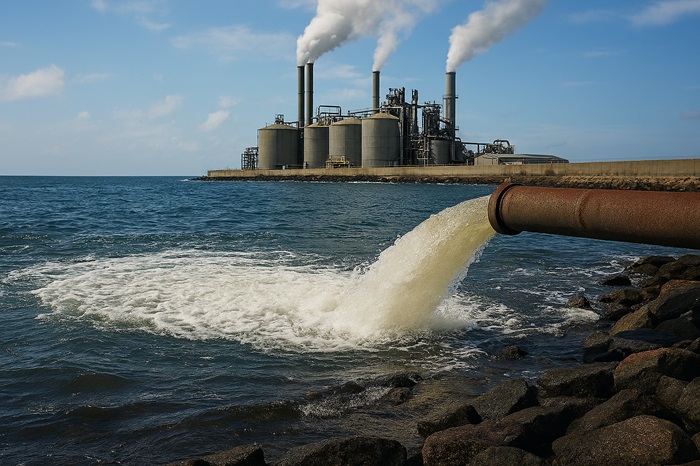
Marine pollution from land-based sources poses a major environmental threat to coastal states. This pollution – stemming from untreated wastewater and industrial discharges- endangers marine ecosystems, public health, coastal tourism, and maritime economies. This dissertation of Martin P. Massawe examines Tanzania’s legal framework for addressing land-based marine pollution, focusing on the role of courts and access to justice in environmental enforcement. Through doctrinal legal analysis and empirical research, the study assesses the practical effectiveness of existing legal instruments. Tanzania offers a compelling case study. Despite progressive environmental laws, government and academic reports show that much industrial and domestic wastewater is discharged untreated, ultimately polluting coastal waters and the Indian Ocean. This gap between the regulation and the reality raises critical questions about the framework’s effectiveness. Internationally, Tanzania is bound by key treaties such as the UN Convention on the Law of the Sea and the Nairobi Convention, which require states to prevent, reduce, and control land-based pollution. Tanzania has enacted national laws to meet these obligations, yet significant legal and practical barriers hinder enforcement. A major obstacle is restrictive locus standi rules, which limit environmental litigation to individuals who can prove direct personal harm. This restricts citizens and NGOs from challenging environmental degradation. In his analysis, Massawe found that while the High Court in Onesmo Olengurumwa v Attorney General (2021) initially upheld these restrictive rules, but that the legal framework itself was unconstitutional. After the publication of Massawe’s article with this conclusion, the Supreme Court reversed the High Court’s position, marking a pivotal shift in environmental litigation. Another significant barrier is government immunity, which shields public authorities from accountability. A key issue is the requirement for governmental bodies to obtain the Advocate General’s approval before suing one another. This research revealed an internal guideline mandating mediation as a prerequisite for such disputes. In practice, this renders it nearly impossible for supervisory authorities to take legal action against other administrative bodies – even when those bodies are major contributors to water pollution through their actions or neglect. The dissertation also explores practical barriers through a case study of the Msimbazi River, heavily polluted by industrial and domestic wastewater. Despite severe pollution, litigation remains rare. Interviews with regulators, judges, and stakeholders reveal that high costs, low public awareness of environmental rights, insufficient judicial expertise, and NGO reluctance to pursue cases all weaken enforcement. In conclusion, while Tanzania’s legal framework aligns with international standards, its effectiveness is undermined by legal and practical challenges. Addressing these issues would strengthen environmental protection, support sustainable development, and help Tanzania fulfil its obligations. These findings are relevant beyond Tanzania, including for countries like the Netherlands. Rules on water protection are only relevant if it combines with a relevant judicial framework.
This research is conducted under the supervision of prof. Albertjan Tollenaar from the University of Groningen and dr. S. Bakta from Mzumbe University.
Martin P. Massawe
Functioning of the Regulatory Framework on Marine Pollution from Land-based Sources in Tanzania
The dissertation is published in the Vakgroep Bestuursrecht en Bestuurskunde series of the University of Groningen and is available in the repository of the University of Groningen.