

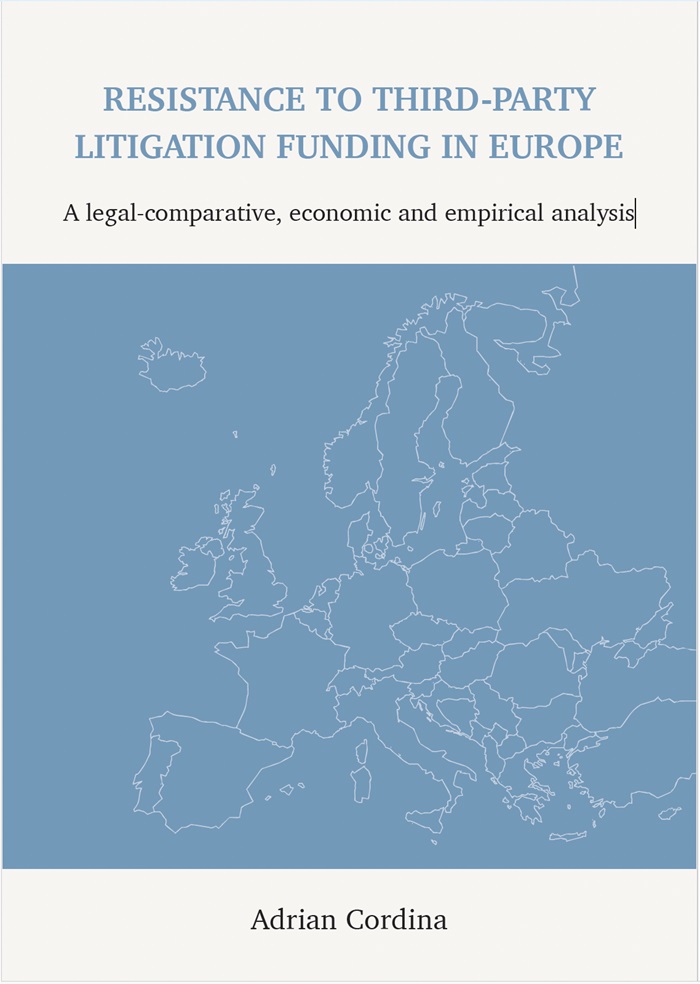
European civil justice systems face constrained budgets and mounting litigation costs, posing a signification challenge both to access to justice from a legal point of view and social welfare from an economic point of view. While the third-party funding (TPF) of litigation is promoted as one promising solution to this problem, it also meets significant resistance. This research of Adrian Cordina explores why TPF is still viewed with caution and whether this caution is warranted. Access to justice issues in Europe and the shift from public to private means of funding are first briefly investigated. The relevant rules which apply to TPF on a European-wide level, and in the Netherlands, England and Wales and Germany are outlined and complemented with historical and cultural elements. The law-and-economics discipline is then applied to theoretically analyse the behaviour of the actors involved in order to address the research questions, with the specific diverging situations in each jurisdiction taken into account. Interviews collect insights to explore and describe the TPF industry, perspectives and experiences. These are tested against the findings arrived at through the aforementioned analysis, in addressing the justifiability of the resistance TPF encounters. It is found that the cost and risk associated with litigation, along with the decline of public legal aid, continue to undermine effective access to justice for meritorious claims in Europe. Among the alternative forms of private litigation funding on the rise, result-based funding such as third-party funding encounters considerable unwarranted resistance. While the European Parliament Resolution on third-party funding calls for a rather restrictive regulatory approach and the European Commission’s Mapping Study highlights the diverging approaches across Member States, the European Law Institute’s Principles present a more balanced and supportive framework by promoting informed claimant choice. Third-party funding does not present significantly larger conflict of interest and agency issues than comparable funding arrangements such as hourly fees, contingency fees and legal expenses insurance. Resistance mainly emerges from the private interests of certain special interest groups such as the corporate and insurance lobbies, and may disproportionately influence perceptions, discourse and regulatory outcomes.
Cordina defended his thesis on November 26th 2025 at the Erasmus University Rotterdam. Promotors: prof. mr. dr. Xandra Kramer and prof.mr. dr. Louis Visscher.
Adrian Cordina
Resistance to Third-Party Litigation Funding in Europe: A legal-comparative, economic and empirical analysis
This dissertation is available at the repository of the Erasmus University Rotterdam via pure.eur.nl/ws/portalfiles/portal/213723252/AC_Thesis_Printing_Version.pdf
ISBN 978 94 6522 989 8