

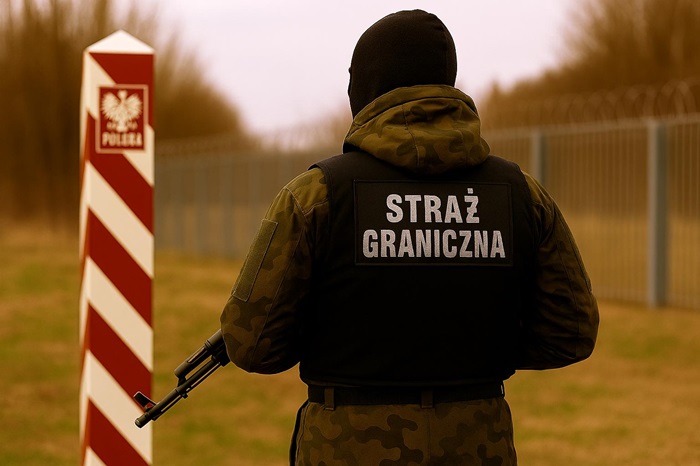
The dissertation by Maryla E Klajn, examines how border control is practiced within the Schengen Area, focusing on the Polish-German border as a case study. While Schengen is commonly understood as having removed internal borders, this research demonstrates that border control has not disappeared, but rather transformed and relocated into everyday practices of enforcement. The study adopts a socio-legal and ethnographic approach, based on more than 900 hours of fieldwork with the Polish Border Guard. This includes participant observation, interviews, focus groups, and qualitative surveys. By focusing on street-level officials, the research shifts attention from formal legal frameworks to the discretionary practices through which law is interpreted and applied in real time. The dissertation is situated within the framework of ‘crimmigration,’ referring to the increasing convergence of criminal law and migration control. It shows how discretionary decision-making by border officials plays a central role in shaping mobility, producing distinctions between those who are allowed to move freely and those who are subject to control. These decisions are influenced not only by legal rules, but also by institutional norms, emotional dynamics, and historical narratives related to security and national identity. Empirically, the dissertation highlights several key dynamics. First, it demonstrates that border control within Schengen persists through informal and selective practices, even in the absence of systematic checks. Second, it shows how discretion operates across multiple levels - legal, organizational, and individual - leading to variation and unpredictability in enforcement. Third, it reveals the importance of affect and emotion in decision-making, as well as the role of secrecy and institutional culture in shaping how authority is exercised. Particular attention is given to the underexplored practice of intra-Schengen forced returns of EU citizens, which challenges assumptions about free movement within the European Union. The findings contribute to socio-legal scholarship, border criminology, and migration studies by foregrounding Central and Eastern Europe-regions often underrepresented in existing research - and by providing a bottom-up perspective on the functioning of European border regimes. The dissertation argues that understanding border control requires attention not only to legal norms and policy design, but also to the everyday practices through which these are enacted. From a societal perspective, the research raises questions about fairness, accountability, and the rule of law in migration governance. By demonstrating how discretionary practices shape experiences of mobility and belonging, it contributes to broader debates on the future of Schengen, the limits of legal harmonization, and the implications of securitization within the European Union. Klajn defended her thesis on March 25th 2026 at Leiden University. The dissertation was written under the supervision of prof. dr. Maartje van der Woude (Leiden University), prof. dr. Helene Gundhus (University of Oslo), and prof. dr. Joanne van der Leun (Leiden University). It is presented as an article-based dissertation.
Het onderzoek van Klajn, als promovendus verbonden aan het Van Vollenhoven
Instituut, maakt deel uit van het Vidi-project Getting to the Core of Crimmigration dat gericht is op het ontrafelen van juridische en maatschappelijke veranderingen en interacties binnen de criminalisering van migratie in de Europese context.
Maryla E Klajn
Agents of Change? (Hi)stories, Perspectives, and Everyday Practices of Polish Border Guards