

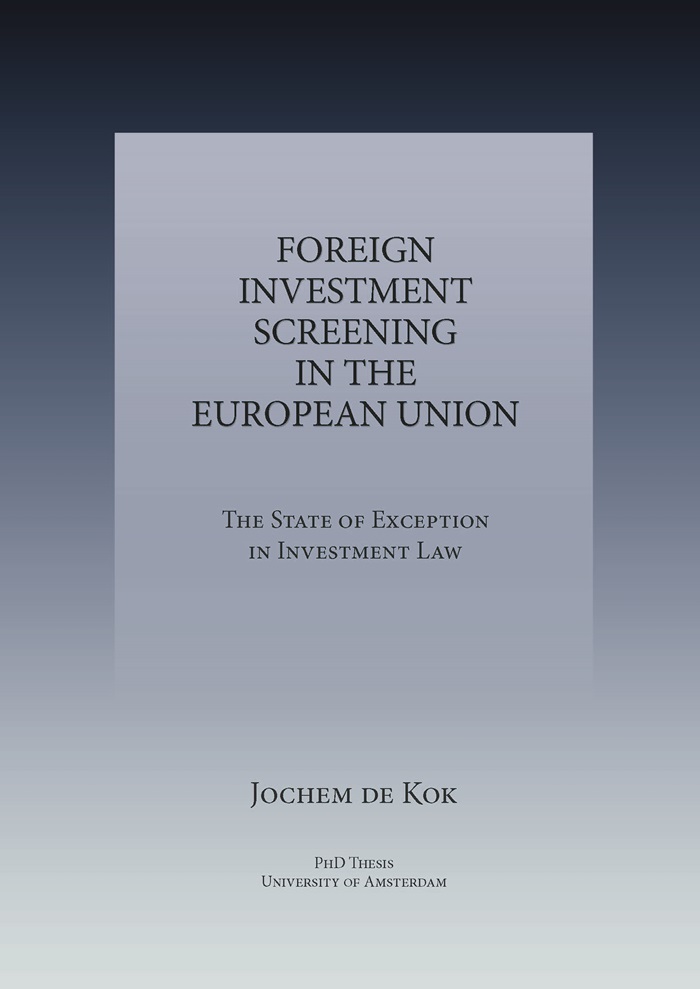
This thesis of Jochem de Kok argues that the institutionalisation of security as a dominant paradigm under the FDI Screening Regulation results in a state of exception in EU investment law. The European framework for foreign investment screening is characterised by a lack of clear screening criteria, a shift from bureaucracy to political decisionmaking processes, a lack of transparency, and challenges to judicial review. This results in the blurring of law and fact and a subtle shift away from the rule of law. The state of exception in investment law is moreover characterised by a friend–enemy paradigm and a conflation of security, economic and geopolitical interests. While the public interests pursued by investment screening are important, it is critical to develop an alternative paradigm for regulating public interests in investment law.
The thesis analyses the FDI Screening Regulation through the lens of the legal-philosophical theory of the state of exception. Drawing on the theories of Carl Schmitt, Giorgio Agamben and Achille Mbembe, the thesis identifies three key themes: the relationship between the security exception and the rule of law, the friend-enmity paradigm and the relationship between the state of exception and economic interests.
Against the backdrop of the liberalisation paradigm under the Treaties, the adoption of the FDI Screening Regulation represents a significant development in EU investment screening law. The FDI Screening Regulation offers the Member States considerable flexibility to determine whether and how to screen foreign direct investments. Despite the primary responsibility of the Member States, the FDI Screening Regulation has given the Commission in an important role in the development of EU investment screening law and policy. Because the regulation of investment screening in the EU is subject to a legal framework established by the Treaties and the FDI Screening Regulation, the FDI Screening Regulation is not representative of a state of exception as envisaged by Schmitt. However, viewed from Agamben’s perspective, the institutionalisation of security as a central paradigm of governance of foreign investments reflects the transformation of the security exception into a normal technique of government. The FDI Screening Regulation provides for an open-ended legal framework and the political decision-making process, in which the boundaries of the security and public order exception are largely determined by politics. The dominance of the security paradigm marks a departure from a rule-based, transparent, and predictable legal order grounded in liberalisation, towards a security-driven regime defined by broad administrative discretion, vague criteria, and politicised decision-making. A further manifestation of the state of exception lies in the significant constraints on effective judicial oversight. Under the security paradigm, screening practice is shaped by a friend-enemy paradigm, which frames foreign investors as trusted allies or security threats.
The thesis illustrates the wide range of security, economic and geopolitical interests pursued by investment screening. It concludes that global geopolitical and technological developments call for a reassessment of the basic principles underpinning the European economic order, including the progressive abolition of restrictions on foreign direct investments and the free movement of capital. To resolve the state of exception in EU investment law, the legal framework should be amended through the specification of clear, objective, and non-discriminatory screening criteria that reflect the close relationship between security, economic and geopolitical considerations.
De Kok defended his thesis on December 10th, 2025 at the UvA (University of Amsterdam). Promotor: prof. dr. Christina Eckes; copromotor: dr. Geraldo Vidigal.
Jochem de Kok
Foreign Investment Screening in the European Union: The State of Exception in Investment Law
De dissertatie is nog onder embargo. Delen van het proefschrift zijn in te zien via pure.uva.nl/ws/files/193432588/17280_2024_30.pdf en via brill.com.
Commerciële uitgave wordt in de loop van 2026 verwacht.